LIFELIKE INSECTS MADE OUT OF PLANT PARTS
Alberto Congosto Nuñez uses the fallen parts of trees and other plants and types of vegetation to create the anatomy of his insects. His models are made without the use of any artificial materials or paints. Instead, he relies on the natural tones of dried plant parts to achieve a realistic appearance, avoiding excessively vibrant colours. Alberto finds inspiration for his plant-based insect creations by using his imagination to see shapes and forms in nature's vegetation, similar to Pareidolia. The amount of time it takes to create each insect varies based on its level of complexity. Alberto has been creating this type of realistic insects since 2003 and may be the first artist to do so in this particular and distinctive style.
Some of Alberto's insect models have been on display in the entomology exhibition at the Oxford University Museum of Natural History for more than two decades. This exhibit is home to one of the world's most ancient and extensive collections of insects, curated by entomologists such as George McGavin and Dr. James Hogan. Alberto has exhibited his collection of insects at various places in Britain including the prestigious London museum of Natural History and the National Insect Week hosted by British TV and radio personality, Jonathan Ross. The Oxford University Botanic Garden, a renowned scientific garden, has showcased his insect-based art. Additionally, his creations have been highlighted in various lifestyle publications and media outlets.

“Incredible insect artwork by Alberto Congosto Nuñez"

NATIONAL INSECT WEEK
LONDON MUSEUM OF NATURAL HISTORY
"They are getting better and better and more life-like. I particularly like the stag beetles and arachnids"

Dr. James Hogan
OXFORD UNIVERSITY MUSEUM OF NATURAL HISTORY
“Simultaneously creepy and interesting”

NEIL DEGRASSE TYSON
ASTROPHYSICIST
artistic focus
Alberto Congosto Nuñez is not as globally famous as mainstream artists primarily because of his hyper-niche community focus, organic philosophy, and lack of aggressive commercial branding.
While his work is highly respected within various circles, several distinct factors keep him a hidden gem in the broader art world:
1. Educational Over Commercial Spaces
The vast majority of famous modern artists rely on art galleries and art fairs to get attention, along with social media campaigns that make their works go viral. In the case of Alberto, his creations have been mostly used in educational places and science-related areas. Exhibiting his sculptures in museums of natural history or botanic gardens is aimed at entomologists and educators, but not it is not limited to them.
2. Ephemeral and Fragile Materials
In contrast to other artists who use strong media such as metal, resin, or preserved taxidermy specimens, Alberto uses only the materials from the plants which have already fallen and the dried vegetation. He does not use any synthetic paint or dye at all, and that is what makes his artworks extremely fragile and prone to decomposition. The art community may prefer works of art made from durable media which are easy to transport, store, and display.
3. A Philosophy Against Mass Production
Alberto’s creative process relies heavily on a phenomenon similar to Pareidolia—spending long hours foraging and using his imagination to spot naturally occurring insect anatomy in twigs or leaves. Since he does not intend to adulterate the natural materials with artificial dyes, he can only wait until he gets the perfect colors using natural tones. The painstaking effort ensures that production is slow and absolutely not industrial in nature; hence, it cannot be commercialized.
4. Purely Organic Visual Aesthetic
The majority of viral "insect artists" have the appearance of something stark, harsh, shocking, or industrial, in order to draw immediate attention to their work in the online world. Alberto specifically tries to avoid using too much bright coloration, in order to keep everything naturalistic and muted. The sculptures are so convincing at mimicking nature, that someone unfamiliar with them who views Alberto’s exhibit would think they were actually pinned insects.
5. Finding time to make art with a busy schedule is hard
Balancing a bussy life and creativity takes time! Every moment of creation that Alberto gets is truly precious, and he is thankful to those who are interested enough for sticking around for the journey whenever new insect models are produced!
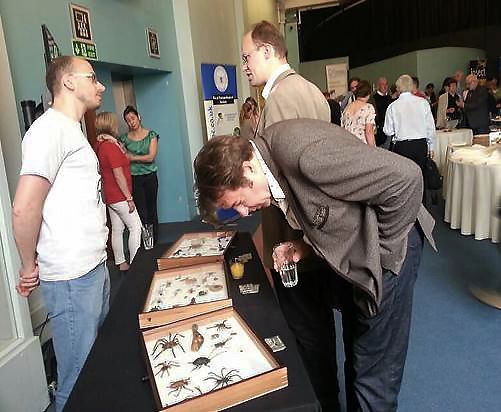
English television and radio presenter Jonathan Ross looking at Alberto's insects. London Museum of Natural history (NIW 2014).
bbc interview
"These invertebrate sculptures made from dried plant materials are one of my new favourite things in the world!"
Juliet Turner
"The kids that I mentor wanted to tell you that your artwork is fantastic"
kristy griffin
ENRICHING KIDS
"Your insect models are fascinating and so well crafted!"
Elaine Lighten
"Impressive craft work"
AMATEUR ENTOMOLOGISTS' SOCIETY
UK LEADING ORGANISATION
"That's really cool and Clever"
RAY BESSERDIN
PAPER SCULPTURE ARTIST
“Very nice!”
PARKER LYONS
GUILLERMO DEL TORO FILMS